


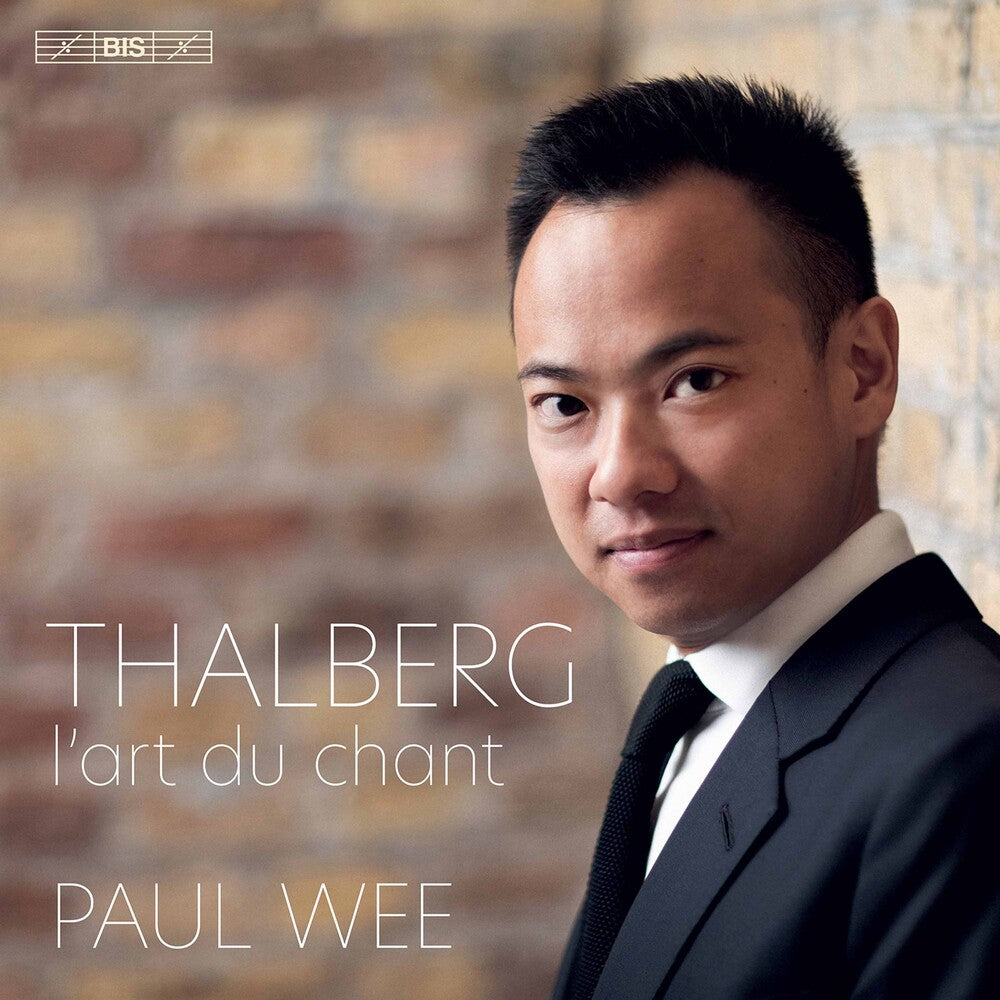
Thalberg / Wee - L'art Du Chant [2 CD]
Thalberg / Wee - L'art Du Chant [2 CD]
...
Fast shipping. Estimated delivery times may vary slightly during high demand.
2 Items = 5% Off, 3 or More = 10% Off
Discount applied automatically at checkout
Couldn't load pickup availability
International lawyer by day and piano virtuoso by night, Paul Wee made his recording début in 2019 with some of the most technically demanding piano music there is: Alkan's Symphony and Concerto for solo piano. He now returns with music which presents a different, but not lesser challenge: how make the keyboard sing. The piano is by nature a percussive instrument - the sound is created by little hammers falling on strings. To create a true legato - or the illusion of it - has been the aim of generations of pianists, but few have taken the matter as far as Sigismond Thalberg. A giant in nineteenth-century pianism, Thalberg was born in 1812, the year after Franz Liszt, his greatest rival on the international concert circuit. In comparison to the latter, Thalberg was often singled out for his ability to make the piano sing, an art which he himself highlighted in a collection of transcriptions aptly named The Art of Singing Applied to the Piano. Published between 1853 and 1863, the collection included Thalberg's adaptations of popular arias by Bellini, Rossini and Weber and songs by Beethoven and Schubert, but also other vocal works, such as Lacrimosa from Mozart's Requiem. This nowadays little-known but fascinating chapter in the history of pianism is presented by Paul Wee, together with a substantial booklet which includes his own liner notes as well as Thalberg's foreword, with the master's advice to those who want their keyboards to sing.
Tracklist:
- L'art Du Chant Appliqué Au Piano, Op. 70, Series 1: No. 1, A Te, O Cara (After Bellini's "I Puritani")
- L'art Du Chant Appliqué Au Piano, Op. 70, Series 1: No. 2, Tre Giorni (After Ciampi) [Attrib. Pergolesi's P. 106]
- L'art Du Chant Appliqué Au Piano, Op. 70, Series 1: No. 3, Adelaide (After Beethoven's Op. 46)
- L'art Du Chant Appliqué Au Piano, Op. 70, Series 1: No. 4, Pietà, Signore (Attrib. Stradella)
- L'art Du Chant Appliqué Au Piano, Op. 70, Series 1: No. 5a, Lacrimosa (After Mozart's K. 626)
- L'art Du Chant Appliqué Au Piano, Op. 70, Series 1: No. 5b, Sull'aria (After Mozart's K. 492)
- L'art Du Chant Appliqué Au Piano, Op. 70, Series 1: No. 6, Perchè Mi Guardi E Piangi (After Rossini's &quo
- L'art Du Chant Appliqué Au Piano, Op. 70, Series 2: No. 7, Bella Adorate Incognita (After Mercadante's "Il G
- L'art Du Chant Appliqué Au Piano, Op. 70, Series 2: No. 8, Nel Silenzio Fra L'orror (After Meyerbeer's "
- L'art Du Chant Appliqué Au Piano, Op. 70, Series 2: No. 9, Einsam Bin Ich Nicht Alleine (After Weber's J. 279)
- L'art Du Chant Appliqué Au Piano, Op. 70, Series 2: No. 10, Der Müller Und Der Bach (After Schubert's D. 795
- L'art Du Chant Appliqué Au Piano, Op. 70, Series 2: No. 11, Schelm, Halt Fest! (After Weber's J. 277)
- L'art Du Chant Appliqué Au Piano, Op. 70, Series 2: No. 12, Il Mio Tesoro (After Mozart's K. 527)
- L'art Du Chant Appliqué Au Piano, Op. 70, Series 3: No. 13, Sérénade (After Rossini's "Il Barb
- L'art Du Chant Appliqué Au Piano, Op. 70, Series 3: No. 14, La Dove Prende (After Mozart's K. 620)
- L'art Du Chant Appliqué Au Piano, Op. 70, Series 3: No. 15, Barcarolle (After Donizetti's "Gianni Di Calais&
- L'art Du Chant Appliqué Au Piano, Op. 70, Series 3: No. 16a, Protegga Il Giusto Cielo (After Mozart's K. 527)
- L'art Du Chant Appliqué Au Piano, Op. 70, Series 3: No. 16b, Là Ci Darem La Mano (After Mozart's K. 527)
- L'art Du Chant Appliqué Au Piano, Op. 70, Series 3: No. 17, Sérénade (After Grétry's "L
- L'art Du Chant Appliqué Au Piano, Op. 70, Series 3: No. 18, Assisa A Piè D'un Salice (After Rossini's
- L'art Du Chant Appliqué Au Piano, Op. 70, Series 4: No. 19, Casta Diva (After Bellini's "Norma")
- L'art Du Chant Appliqué Au Piano, Op. 70, Series 4: No. 20, Voi Che Sapete (After Mozart's K. 492)
- L'art Du Chant Appliqué Au Piano, Op. 70, Series 4: No. 21, Fröhliche Klänge, Tänze, Gesänge (Aft
- L'art Du Chant Appliqué Au Piano, Op. 70, Series 4: No. 22, Dafydd Y Garreg Wen
- L'art Du Chant Appliqué Au Piano, Op. 70, Series 4: No. 23, Ein Mädchen, Das Auf Ehre Hielt (After Haydn's H
- L'art Du Chant Appliqué Au Piano, Op. 70, Series 4: No. 24, Fenesta Vascia (After Cottrau)
- 3 Mélodies De Franz Schubert, Op. 79: No. 1, Täuschung (After Schubert's D. 911)
- 3 Mélodies De Franz Schubert, Op. 79: No. 2, Der Neugierige (After Schubert's D. 795)
- 3 Mélodies De Franz Schubert, Op. 79: No. 3, Die Post (After Schubert's D. 911)
- Auf Flügeln Des Gesanges (After Mendelssohn's Mwv K 86)
- 10 Piano Pieces, Op. 36: No. 3, Mi Manca La Voce (After Rossini's "Mosè In Egitto")
UPC: 7318599925158
Label: Bis
Release Date: 11.6.20
Format: CD
Let customers speak for us
All good here!Luv the CD!😎

Fits great! Looks sharp! Lemmy would approve.

![Wilson Fairchild - Statler Made [CD]](https://cdn.shopify.com/s/files/1/0278/7223/1499/files/4273578-3078671_250x250.jpg?v=1770181281)
Fast shipping! It’s very well made. My granddaughter loves it & wants to wear it everywhere.

Very great condition.

This is a very good album. I hearsomeot=f the songs on the radio, but it is much better on the cd. The seller was quick in getting it out and to me. Thank You


They went above and beyond to make a gift for my boss special. I appreciate all the effort and work that went into making this happen.

always liked Don's music
![Don Williams - Epilogue: The Cellar Tapes [CD]](https://cdn.shopify.com/s/files/1/0278/7223/1499/files/418467313515_1000_250x250.webp?v=1775532931)
Love the temptations

This is a very good CD. I enjoy listing to music from the 50's 60's 70' and the 80's.

The CD is very good. I enjoy listing to music from the time I was growing up and while I was in the Air Force.
I think it is a great CD. I enjoy listing to it and others CD's from the 60's and 70'

